
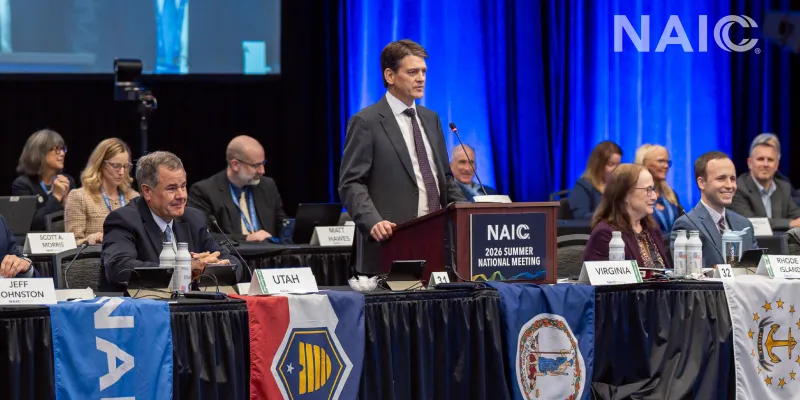

The Power of Innovation to Drive Change: NAIC President White’s 2026 Summer National Meeting Keynote
Throughout its more than 150-year history, the U.S. state-based system of insurance regulation has grown with the country and the insurance industry—adapting and modernizing to continue leading, protecting consumers, and ensuring strong, stable, and secure markets.
This week, state insurance regulators are continuing that tradition during the National Association of Insurance Commissioners’ (NAIC’s) 2026 Summer National Meeting in Columbus, Ohio, a state with its own rich history of innovation.
On Wednesday, Aug. 12, Virginia Insurance Commissioner and NAIC President Scott A. White delivered the meeting’s keynote address, where he highlighted the work of state insurance regulators and the NAIC to drive change in financial solvency regulation, natural catastrophe risk mitigation, and the oversight of emerging technologies.
As he closed, Commissioner White noted, “Everyone around this table and across this room—regulators and the NAIC team—we all share in the responsibility of carrying the state-based system forward into its next chapter.”
Below, you can find Commissioner White’s remarks as prepared for delivery:
****
Thank you, Governor DeWine and Director French, for welcoming us. It’s great to be back here in Columbus, in the state of Ohio.
Before we go further, I also want to thank the state legislators and other state government officials joining us from across the country for our 18th Annual State Officials Program. It’s great to have you with us as we work together to protect consumers and markets.
Many of you will remember our last visit here, in August of 2021, which was held in this same hotel and conference space. This was the first national meeting after the lockdown from the pandemic, part of the gradual reopening of society we were going through at the time. We were still getting used to being together again in person. And while it was exciting to see each other off-screen, we weren’t yet back to normal. Attendance was down, and I remember walking to meetings down hallways without the usual crowds and stepping into conference rooms that were half full.
So, it’s great to be in a packed room for our Opening Session with all of you today. And it was great to hear the tributes from Governor DeWine and Director French celebrating the achievements of their state. Certainly, Ohioans have much to be proud of. The state boasts several native sons whose inventions changed the world.
Thomas Edison, born in Milan, Ohio, is best known as the inventor of the light bulb. Developing an electric light was something scientists had been working on for over 50 years, but it was Edison whose invention of the long-lasting incandescent light bulb forever changed how society functions when the sun goes down.
And then there’s the Wright Brothers, who of course invented and flew the world’s first successful motor-operated airplane. Now I know Commissioner Causey will be quick to point out that this flight took place on the dunes of Kitty Hawk in 1903, but Orville and Wilbur perfected the design of their aircraft at a bicycle shop in Dayton, a little over an hour’s drive east of here. And we all understand the importance of this achievement: It shrunk global distances and eventually led humanity to the space age.
Few examples capture the power of innovation to drive real change better than these. And their stories carry another lesson: Real progress takes time. It comes from years of steady effort and from pushing through setbacks along the way.
In our world, there’s no better example of how innovation can drive change than the modernization of our financial solvency framework that began in the early 1990s. This effort began after a wave of insurer insolvencies raised real questions about the ability of states to properly assess insurers’ financial condition.
Understanding that real change was needed, the NAIC and Member states embarked on an ambitious series of reforms that transformed how states collectively evaluate an insurance company’s financial strength. Think of the Accreditation Program, the move from minimum capital requirements to Risk-Based Capital, and the Investment Model Law. Another important reform was moving from an approach to financial examinations that broadly tested past financial data to one that focuses on the insurer’s most significant current and emerging risks. That’s what we refer to now as a risk-focused approach.
A young, bright-eyed, and bushy-tailed Jeff Johnston, who had joined the NAIC a year earlier, was given the responsibility of teaching this new approach to state insurance regulators. Over the course of the next two years, Jeff crisscrossed the country, traveling to cities like Columbus, where in ballrooms and breakout spaces, he patiently walked small teams of regulators through a process that challenged long-standing practices and reshaped how states approached financial analyses and examinations.
And here we are, thirty years later, and that effort has helped build a U.S. state-based system that stands as a global model—one resilient enough to navigate the Great Financial Crisis and adaptable enough to keep pace with new and emerging risks. So, as we celebrate Jeff’s first national meeting as CEO, we also recognize that his journey is part of a broader legacy: a state-based system defined by its willingness to modernize, its commitment to continual improvement, and its deep belief that strong solvency oversight protects consumers best when it never stops evolving.
And it remains the foundation for responding to the transformative changes we’re seeing in the life sector today—from the rapid expansion of private credit to the growing use of offshore reinsurance structures.
As I was preparing my remarks and thinking about the last time we were in Columbus, my mind went back to the Commissioner’s Roundtable, held in this room. We’d finished our agenda, and when we reached “Any Other Matters,” our former NAIC president, Maine Superintendent Eric Cioppa, asked to address an issue he thought deserved our attention. And so Eric began, in his soft, measured voice, to discuss several developments that were emerging in the life industry. He described the growing role of private‑equity‑owned insurers and their shift into more complex, illiquid assets. We needed to understand this shift, he told us, and respond in a way that protected consumers. For most of us around the table, this was completely new information we were absorbing. And in hindsight, his words on that day were prescient.
Five years later, we’re meeting this challenge by developing new standards for assessing investment risk. We're scrutinizing the ratings we rely on, requiring more transparency and analysis of insurers’ investment portfolios. And we're ensuring our regulators have the tools to make sound judgments on complex instruments.
We all mourn the loss of Eric, who left us earlier this year. But I think he would be proud of the work we’ve done to protect policyholders from the risks he described, with private credit at its center. This has been our consistent message to policymakers, the media, and federal and international regulators. In May, we met with Secretary Bessent at the Treasury Department to highlight our work in this area, and both during and after the meeting, Treasury reaffirmed its support of the state-based system.
It’s not just our work on solvency regulation where innovation is driving our efforts. We’re developing new ways to address the risks from natural catastrophes, which, along with inflation, rebuilding costs, and changing risk profiles, are putting real pressure on homeowners’ insurance markets across the country.
This has been a top priority going back to at least 2020, when the NAIC created an executive-level task force with commissioners from more than 40 states. But I would argue that the roots of our work today can be traced to May 2019, when a small group of commissioners and senior staff met at the site of the devastating wildfire in Paradise, California, that left 85 people dead, displaced nearly 30,000 people, and destroyed more than 10,000 homes.
At the time, it was the deadliest wildfire in over 100 years. The meeting, organized by Commissioner Lara, who had been in office only four months, also included Jeff Czajkowski, who had joined the NAIC the prior year to lead the Center for Insurance Policy and Research (CIPR).
Those who were there that day describe the ground still smoldering six months after the fire and a steady flow of trucks driving up and down the roads as part of an enormous environmental cleanup. The experience left a deep impression with everyone who was there. Jeff talks about this meeting as being a turning point for the direction of the CIPR. He recalls that as he was leaving the hotel after the meeting ended, then-Commissioner Andrew Stolfi ran up to him and said, “We’d like you to come to our Western Zone meeting this year to see if there’s more work we can do to address wildfire risk.”
And that’s exactly what happened. The meeting in Mount Hood, Oregon, later that fall kicked off work on developing catastrophe modeling and mitigation programs that expanded our focus beyond hurricane and windstorm perils to address wildfire risk.
The support that emerged from that gathering seven years ago set the NAIC on a path to today’s Catastrophe Risk Management Center of Excellence. In the years since, the Center has grown to support risk mitigation work across more than twenty states, spanning multiple catastrophe-related focus areas, licensing its own catastrophe models, and equipping regulators with new training and tools. The continued engagement of regulators and NAIC staff for this work shows a sustained commitment to both innovation and resilience. And that remains, along with our support for one another, critically important in light of disasters such as the current wildfires out West.
CIPR has also done work to help state regulators better understand our homeowners markets to support informed, data-driven decision-making. Just last week, it released the Examining Homeowner Property Insurance Market Dynamics report, which includes state-level data from 2018 to 2024.
This landmark report helps separate broad trends from local conditions and identify where actions may be most needed. It shows that consumers broadly still have options in a generally strong homeowners’ market and that insurers continue to write and renew business. At the same time, cost pressures are real, market stress is emerging in certain regions, and availability challenges persist in some higher-risk geographies. None of that should surprise anyone in this room. But now we can talk about it with data and not just as anecdotes or isolated examples.
Building on this report, the Homeowners Market Data Call issued in March will give us an even more complete picture. It will offer a more granular view of market conditions, provide deeper insight into affordability and availability, and will help us better understand regional and geographic differences. This information will be essential as we evaluate mitigation programs, analyze non-renewal trends, and assess availability.
This data‑driven work is helping us confront homeowners’ market challenges with greater clarity and precision than ever before.
And just as we’ve modernized our approach to catastrophe risk, we’re now facing advances in technology and artificial intelligence that are reshaping the very systems we regulate.
Our current work in this space reflects the growing need for regulators to understand how insurers are using AI and to ensure those systems function in ways that are fair, reliable, and aligned with state law. As AI becomes more deeply embedded in insurer activities that affect consumers, we need a clear view into how these tools work and the ability to evaluate whether appropriate oversight is in place.
This week, we’ll continue advancing the core work being done in this area: first, the continued development of an AI Risk Evaluation Supplement through a 12-state pilot program, and second, the creation of a regulatory framework to strengthen oversight of third-party data and model vendors. Both of these initiatives build on a strong foundation the NAIC laid several years ago, beginning with the adoption of our AI principles and followed by the issuance of the AI Model Bulletin. Together, those initiatives clarified how existing state laws apply to insurers’ use of AI and established shared expectations across jurisdictions.
And I want to pause here to recognize Kathleen Birrane, former Maryland insurance commissioner, who we lost suddenly and unexpectedly earlier this year. Kathleen was the inaugural chair of our H Committee, and she was the primary drafter of the AI Model Bulletin. She believed strongly in the need for clarity and consistency in regulating emerging technologies. I truly think she saw the Bulletin as the crowning achievement of her very distinguished career. Kathleen was so proud of her work at the NAIC and liked to say we were “her people,” even after she returned to private practice. She is greatly missed.
Of course, our efforts in regulating insurers’ use of AI are closely related to ensuring operational resilience in the face of cyber incidents. The June cyber incident at the NAIC, part of a larger picture where multiple other organizations were also targeted, was a reminder that we ourselves are not immune to the risks we oversee. Our systems are essential to facilitating the collaboration and stability of the state-based regulatory system, and how we responded to that incident is a real-time example of resilience.
We take real pride in how our teams handled it: with transparency about what happened and with an unwavering commitment to protecting the systems, the data, and the trust this organization runs on. I want to thank the staff, the Member departments, and the partners who worked around the clock on the response. That trust is exactly what allows us to keep doing the work of protecting consumers and supporting strong insurance markets.
Finally, if you take away anything from my remarks today, it’s understanding how regulators are responding to an increasingly complex and rapidly changing industry both through innovation and through more sophisticated analytical and surveillance tools. And this of course requires a real investment in our people, because none of this means anything unless the regulators using it are trained to keep up.
And this is what our designation program is designed to help do. This year marks the 20th anniversary of the Insurance Regulator Professional Designation Program. Launched in 2006, it's now the premier professional development program for state insurance regulators anywhere in the country. Thousands of regulators have come through it. Thousands of designations have been earned. We celebrate the decades of investment in the people who do this work, and I think it deserves a real round of applause.
In closing, I’ve tried to offer a few examples today that show how the NAIC and states have responded over the years to many of the challenges facing us today. How earlier leaders laid the foundation and how we are continuing to build on it through innovation. And while history gives us famous stories of invention and progress like those of Thomas Edison and the Wright Brothers, I’m more drawn to those examples of leadership that have shaped our own system and how we are continuing to build on it now through innovation.
The legacies of Eric and Kathleen, the work of Jeff Johnston, Jeff Czajkowski, Ricardo, and so many others. They’re a reminder that each of us has the opportunity to contribute to that same tradition of leadership and leave a meaningful mark on the insurance regulatory system. Everyone around this table and across this room—regulators and the NAIC team—we all share in the responsibility of carrying the state-based system forward into its next chapter.
Thank you for making time to join us in Columbus, and I look forward to the work we’ll do together this week.
Thank you again for joining. And with that, we are adjourned.
###
About the National Association of Insurance Commissioners
As part of our state-based system of insurance regulation in the United States, the National Association of Insurance Commissioners (NAIC) provides expertise, data, and analysis for insurance commissioners to effectively regulate the industry and protect consumers. The U.S. standard-setting organization is governed by the chief insurance regulators from the 50 states, the District of Columbia and five U.S. territories. Through the NAIC, state insurance regulators establish standards and best practices, conduct peer reviews, and coordinate regulatory oversight. NAIC staff supports these efforts and represents the collective views of state regulators domestically and internationally.