

Proactive Leadership, Ambitious Solutions: NAIC President Scott White on State-Based Regulation in an Evolving Marketplace
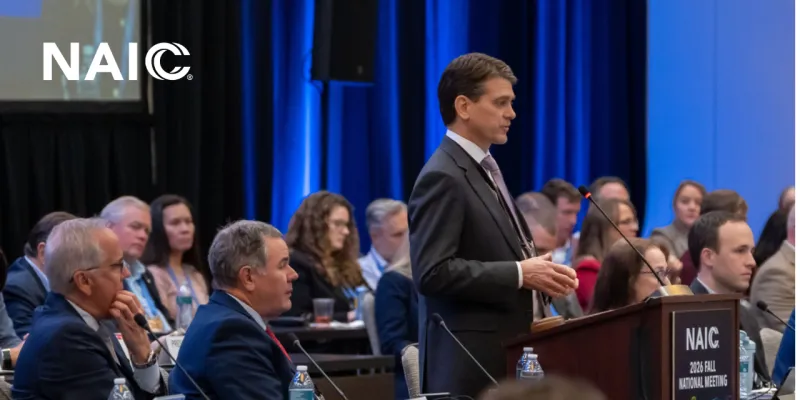
Today, Virginia Insurance Commissioner and National Association of Insurance Commissioners (NAIC) President Scott White delivered a keynote address at the organization’s 2026 Fall National Meeting that expressed his confidence in the U.S. state-based insurance regulatory system’s ability to lead in a time of rapid change.
“What gives me hope is that this is an organization that isn't afraid of tackling hard problems with ambitious solutions,” said Commissioner White. “And you see us do that in issue after issue.”
Whether it’s strengthening resilience to severe weather, overseeing insurers’ use of artificial intelligence, reinforcing regulatory frameworks, or other initiatives, state insurance regulators are addressing challenges facing consumers and markets through proactive, data-driven work that anticipates emerging risks.
“[T]his organization consistently demonstrates a commitment to peering over the horizon and asking what insurance regulation should look like years into the future,” noted Commissioner White.
As he closed, he observed, “We’re not always going to agree on every issue or every solution. But I firmly believe we’re united by a common purpose: protecting consumers and supporting strong, competitive insurance markets.”
You can read Commissioner White’s full remarks, as prepared for delivery, below:
****
So, here we are at the Fall National Meeting, trying to get a lot of work across the finish line, and we’re already thinking about what lies ahead next year.
Some of us just returned from Hong Kong for the IAIS Annual Conference. It was a long trip. Nearly fifteen hours here to Dallas.
Although, I bet everyone in this room is now probably thinking about your own travel experiences to Dallas. Maybe 15 hours was a short trip after all. Hopefully it will be smoother sailing on your way home, though.
But somewhere over the Pacific, I had this idea that I would use that flight here to reflect. No meetings, no calls, no emails. Just time to think about everything we've done this year. All the challenges we've faced, all the people I've met, and the rich conversations I've had with so many of you.
But then the Ambien kicked in, and the next thing I knew, we were sitting on the tarmac in Dallas.
And this brings up something that comes up frequently for us officers or committee chairs who are out speaking about the work of the NAIC, and that’s the travel. In many ways, it's built into the role of NAIC president. And I don't bring that up looking for sympathy. I bring it up because I find it to be time very well spent.
Because while people often ask about the travel, what they don't ask as often is what I've learned from it. And after all the conferences, the fireside chats, the keynote addresses, and the panel discussions, I've noticed that the discussion often comes back to the same question: Can insurance regulators keep pace with change?
And honestly, it's a fair question, because the reality is that the industry we regulate is changing faster than at any other point I can remember.
Insurance markets are more interconnected than ever before. New technologies are transforming how products are designed, distributed, and serviced. Consumer expectations continue to evolve. Capital markets are influencing business models in new ways. And emerging risks continue to force all of us to ask new questions.
And just think about where we were only five years ago.
Five years ago, we weren't talking about generative AI.
Five years ago, catastrophe losses exceeding $100 billion were not viewed as almost routine and increasingly driven by secondary perils such as hail.
Five years ago, conference agendas weren't dominated by discussions of private credit.
And offshore reinsurance certainly wasn't attracting the level of attention it receives today.
Five years isn't a very long time. But in the insurance industry and our regulatory world, it can feel like an entirely different era.
And that's what brings me to my second theme that has shaped many of my remarks this year.
While the industry may be rapidly changing, both the states and the NAIC are evolving and modernizing to meet those changes.
Throughout this year, I've spoken about our work on natural catastrophe risk, artificial intelligence, and the developments in the life insurance sector. And what connects those issues is not simply the subject matter; it's the approach. One that’s rooted in anticipating emerging risks, understanding them early, and responding thoughtfully before they become larger problems.
And to me, that's what modern insurance regulation looks like. Nowhere is that vision clearer than in the Market Regulation Modernization project led by Director Gillespie and Director Nelson. Over the past year, they’ve led discussions with regulators, industry representatives, and consumer advocates that examine what is working in our current framework and where improvement is needed.
And through those conversations, a common vision emerged: a regulatory framework built around timely, trustworthy data. One that allows regulators to identify issues more quickly, collaborate more effectively, and provide greater transparency for consumers. In short, a framework designed for today's marketplace rather than yesterday's.
What's exciting is that this isn't simply a vision for the future. In many respects, we're already doing it.
Whether it's our response to catastrophe events, our efforts to better understand insurers' use of artificial intelligence, or the additional transparency we're pursuing in areas such as investments and reinsurance, we're already using smarter tools and better information to become more proactive and effective regulators.
The future isn't something we're waiting for. In many ways, it's already here in our approach to regulation today.
And that brings me back to the conversations I've had this year. Because, after all these panels and discussions, there is one question that stays with me more than any other.
It's not about specific questions about AI or catastrophe risk or private credit.
It's this: "What makes you optimistic or gives you hope about the future?"
And my answer is always the same. What gives me hope is that this is an organization that isn't afraid of tackling hard problems with ambitious solutions. And you see us do that in issue after issue.
Take our work on flood insurance. We all know it represents one of the largest protection gaps facing consumers today. And we also know that we don't control every lever available to address that challenge since flood insurance is primarily sold through the National Flood Insurance Program.
But instead of accepting that reality, we've spent this year developing an ambitious Flood Insurance Blueprint, led by Director Nelson (she’s had a busy year) focused on the tools we do have available to help consumers better understand their risk and coverage options.
You also see it in our work on life insurance illustrations. For many years, concerns were raised about whether current disclosure and projection standards created unrealistic consumer expectations regarding policy performance and retirement progress. Yet, there was no meaningful progress on efforts to address these concerns.
But under the leadership of Commissioner Ommen and Director Fox, and through the tireless efforts of Minnesota's Ben Slutsker, we are finally seeing meaningful movement on an issue that has challenged regulators for a long time.
You see it in our willingness to have difficult conversations about offshore reinsurance and the need to consider additional capital requirements for business ceded to non-reciprocal jurisdictions.
Now, we know these can be challenging discussions, and certainly not everyone agrees on each point, but we’re committed to pursuing these and other regulatory initiatives through thoughtful engagement, honest debate, and a willingness to confront hard questions directly.
What also gives me hope is that this organization consistently demonstrates a commitment to peering over the horizon and asking what insurance regulation should look like years into the future.
In addition to the countless policy and standard-setting initiatives underway across the NAIC, we're finalizing a comprehensive five-year Strategic Plan.
We're also continuing long-term modernization efforts across multiple regulatory frameworks.
Much work is underway or completed on our insurer investment framework and related work focused on credit rating providers and risk-based capital model governance.
We're implementing our National Climate Resiliency Strategy.
And as I just spoke about, we're actively examining what the future of market regulation should look like.
We've even undertaken a review of our governance and bylaws, an initiative led by Director Dwyer.
To me, this demonstrates that the NAIC is not only an organization that is able to keep up with the rapid pace of change, but it’s able to do so while also being focused on the longer-term work of building the regulatory frameworks that will serve consumers and markets for decades to come.
And this is no accident. I want to take a moment to recognize the outstanding leadership of our CEO, Jeff Johnston, and the entire NAIC team. Throughout this past year, Jeff and his team have patiently listened to the Members’ views about the work we should be focused on, and they’ve given us the tools and resources we need to accomplish that work.
I also want to thank my fellow Officers, the Members around this table, and your teams for your partnership, your engagement, and everything we've accomplished together.
And I'd be remiss if I didn't thank my team back in Virginia. I'm incredibly proud of the work you do every day, and I could not have served in this role without your support.
Now, we all know this membership is going to look a little different next year. And as I've thought about that, I've been reminded of the ancient story of the Ship of Theseus.
Stay with me on this.
The story goes that as the ship aged, each worn board was gradually replaced until, over time, none of the original wood remained. The question philosophers debated was simple: “Was it still the same ship or had it become something entirely new?”
Now, if we pose that same question when it comes to the NAIC, it’s clear an organization doesn’t endure for 155 years because it resists change.
It has endured because each generation accepts responsibility for it for a time, hopefully strengthens it, and then entrusts it to the next. And so, I'd like to thank all our departing Members for your service, your friendship, and your lasting contributions to this organization and to the consumers we serve.
Over the past several years, each of these Members has helped lead the NAIC through some of the most significant issues we've faced, from natural catastrophe risk and climate resiliency to artificial intelligence and critical work involving health insurance and consumer protections. The organization is stronger because of your leadership and your service.
And this brings me to someone who will soon be entrusted with leading this organization: my good friend, Beth Dwyer.
So, Beth and I sat together at an Irish pub in Pittsburgh during a SOFE conference back in May of 2022, and we talked about whether either of us should take the leap and run for NAIC officer.
We agreed on two things. Whoever ran first, the other would support them. And if we were fortunate enough to make it through that process, we'd do everything in our power to help each other succeed. And here we are, four and a half years later, as I hand the gavel over to you.
Beth, I could not be more excited to watch you lead this organization next year. You bring extraordinary experience, sound judgment, an ability to build consensus, and a genuine passion for this work.
And I know the NAIC will be in excellent hands.
Well, let me end where I began: with the travel.
After dozens of trips, countless conversations, and more airports and hotel rooms than I can remember, I've come away with a deep confidence in the work we do and the future of the state-based system.
And it's because I've seen firsthand the people committed to meeting those challenges. The Members, the incredible staff in our departments, the outstanding NAIC team, and engaged stakeholders that include industry and consumer representatives.
We’re not always going to agree on every issue or every solution. But I firmly believe we’re united by a common purpose: protecting consumers and supporting strong, competitive insurance markets.
Thank you for the privilege of serving as your president. Thank you for your friendship.
And thank you for the work you do every day on behalf of the consumers we serve.
I'm excited to see what the future holds.
Thank you.
About the National Association of Insurance Commissioners
As part of our state-based system of insurance regulation in the United States, the National Association of Insurance Commissioners (NAIC) provides expertise, data, and analysis for insurance commissioners to effectively regulate the industry and protect consumers. The U.S. standard-setting organization is governed by the chief insurance regulators from the 50 states, the District of Columbia and five U.S. territories. State insurance regulators, through the NAIC, establish standards and best practices, conduct peer reviews, and coordinate regulatory oversight. NAIC staff supports these efforts and represents the collective views of state regulators domestically and internationally.