


Successful NAIC Fall National Meeting Continues Progress to ‘Secure Tomorrow’
Last week, the National Association of Insurance Commissioners’ (NAIC) 2025 Fall National Meeting showcased the collaboration and coordination at the heart of the U.S. state-based insurance regulatory system. State insurance regulators worked together to make progress on key issues as they continue “Securing Tomorrow.”
“For more than 150 years, the state-based system of insurance regulation has led, adapted, innovated, and supported consumers and markets,” said North Dakota Insurance Commissioner and NAIC President Jon Godfread. “I am proud of what state insurance regulators have accomplished together this year to help prepare for the next 150 years and keep our system the global gold standard for insurance oversight.”
The following are just a few examples:
Adopting Risk-Based Capital Guiding Principles
Recognizing the evolution in the purpose and use of risk-based capital requirements, NAIC Members established the Risk-Based Capital (RBC) Model Governance Task Force in February 2025 to modernize and strengthen the RBC framework to respond to emerging market risks and support innovation. The Task Force was charged in part with establishing guiding principles to ensure a consistent approach to future adjustments.
On Dec. 10, the Task Force adopted the principles following multiple public comment periods. RBC is used to help state insurance regulators monitor insurers’ financial health and to identify weakly positioned insurers. The principles will be used to develop governance procedures to future changes to RBC. Governance procedures, along with potential changes to the RBC formulas that are identified in the gap analysis that will be conducted in 2026, will assist in a changing landscape and could help identify at-risk companies early, giving regulators more time to take corrective actions before policyholders are impacted. They will also uphold the RBC framework’s integrity, adaptability, and global competitiveness and further the principle of “Equal Capital for Equal Risk.”
Engaging with Key Partners
Collaboration is a core value that helps drive the success of the U.S. state-based insurance regulatory system, and that approach extends to NAIC Members’ interactions on the local, state, federal, and international levels.
During last week’s meeting, the NAIC hosted its 17th Annual State Government Orientation and Dialogue. State legislators and government officials from across the country joined regulators for dialogues on issues such as artificial intelligence, health insurance, data privacy, the homeowners market, financial oversight, and cybersecurity. Breakout sessions dived deeper into these and other topics.
Such conversations and information-sharing opportunities help fuel timely, effective solutions that advance consumer protections and strengthen the state-based system.
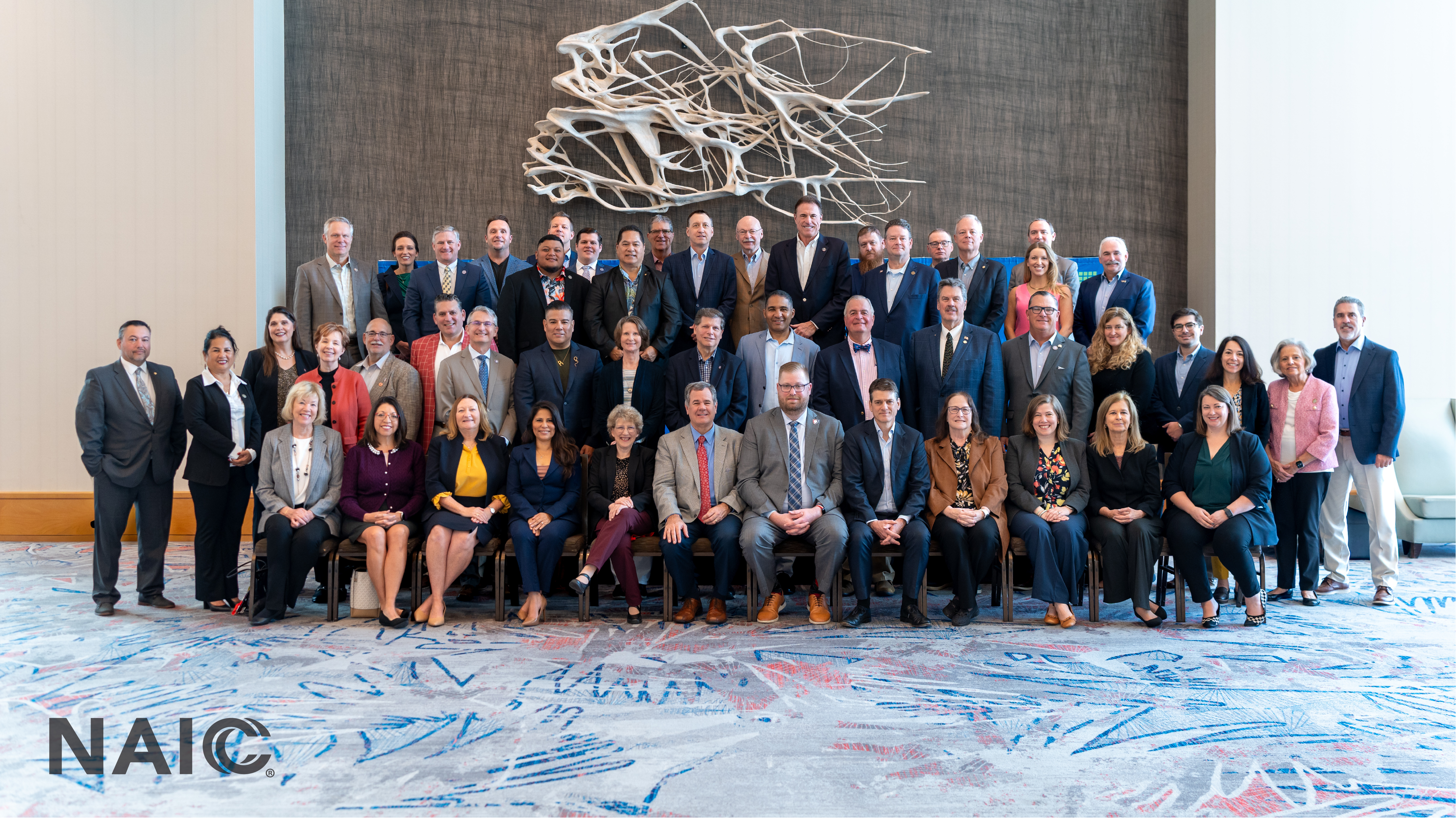
(NAIC Members with state government officials at the 17th Annual NAIC State Government Orientation and Dialogue)
Equipping Regulators
As state legislatures update and enact laws regarding prior authorization practices, the Regulatory Framework (B) Task Force drafted a Prior Authorization White Paper and received public comments in 2025.
The paper, which was adopted during the meeting, lays out key considerations from consumers, providers, and insurers’ perspectives. It also describes actions taken by state governments, the federal government, and interested parties on the issue.
As regulators navigate questions and concerns, the Prior Authorization White Paper will serve as a valuable resource, one that includes several takeaways to inform potential future action.
Increasing Assessment and Analysis Through Detailed Data-Gathering
Following the 2024 Property & Casualty Insurance Market Intelligence Data Call, state insurance regulators are finalizing a new Homeowners Market Data Call for launch in early 2026. On Dec. 11, the Property and Casualty Insurance (C) Committee adopted new templates and definitions for the call, as created by the Homeowners Market Data Call (C) Task Force based on input from state insurance regulators, industry, and consumer representatives.
The call would require homeowners insurers writing at least $50,000 in homeowners direct written premium in participating states to file data for any year from 2018 to 2025, as requested by insurance regulators in their state. In addition to ZIP-code level information on the homeowners insurance market, the call would also collect data on renters, condominium owners, and mobile home coverage.
The data call will support state insurance regulators’ analysis of availability and affordability challenges, mitigation programs’ effectiveness, and solvency implications, while also assisting their efforts to increase consumer awareness.
Maximizing Mitigation and Fully Leveraging Data-Driven Resources
The Climate and Resiliency (EX) Task Force announced a proposal to consolidate the Task Force, the Catastrophe Insurance (C) Working Group, and the NAIC/FEMA (C) Working Group into a new Natural Catastrophe Risk and Resilience (EX) Task Force. This restructuring will build on the Task Force’s progress by broadening the focus to risk-mitigation strategies for all major natural perils and fully leveraging the resources and partnerships available through the Center for Insurance Policy and Research's Catastrophe Modeling and Risk Management Center of Excellence.
A new Pre-Disaster Mitigation & Risk Modeling Working Group will support the ever-expanding number of states implementing mitigation grant programs and coordinate data on mitigation strategies among state regulators and emergency managers, while also increasing training opportunities for state insurance regulators. A new Severe Perils Working Group will address issues and insurance gaps related to hail, atmospheric rivers, severe convective storms, hurricanes, landslides, wildfires, and flooding, with an emphasis on closing protection gaps, supporting innovation, and creating a Flood Insurance Blueprint to help expand the private flood insurance market.
The proposal is open for comment until Jan. 12, 2026.
Positioning for the Future
Nearly 120 years after the NAIC formed the Committee on the Valuation of Securities to develop a uniform national valuation procedure, the 2025 Fall National Meeting marked the last meeting of what ultimately became the Valuation of Securities (E) Task Force (VOSTF).
This January, the Invested Assets Task Force and three subsidiary working groups will replace VOSTF: the Investment Analysis Working Group, the Investment Designation Analysis Working Group, and the Credit Rating Provider Due Diligence Working Group. The modernization move will help adapt regulation to better reflect the current insurance investment environment.
Committee names and structures may change, but the NAIC’s mission of providing members with consistent, unbiased, and grounded investment assessments and research continues.
****
To conclude the meeting, NAIC Members elected the organization’s officers for 2026:
- President: Virginia Insurance Commissioner Scott A. White
- President-Elect: Rhode Island Department of Business Regulation Director Elizabeth (Beth) Kelleher Dwyer
- Vice President: Utah Insurance Department Commissioner Jon Pike
- Secretary-Treasurer: South Carolina Department of Insurance Director Michael Wise
To read more reports from the NAIC’s 2025 Fall National Meeting, visit the event’s Interactive Agenda and follow the NAIC on X, Facebook, and LinkedIn.
About the National Association of Insurance Commissioners
As part of our state-based system of insurance regulation in the United States, the National Association of Insurance Commissioners (NAIC) provides expertise, data, and analysis for insurance commissioners to effectively regulate the industry and protect consumers. The U.S. standard-setting organization is governed by the chief insurance regulators from the 50 states, the District of Columbia and five U.S. territories. Through the NAIC, state insurance regulators establish standards and best practices, conduct peer reviews, and coordinate regulatory oversight. NAIC staff supports these efforts and represents the collective views of state regulators domestically and internationally.